
2022 - 2023
Landa Park Aquatic Center Parking Lot and Bioretention System
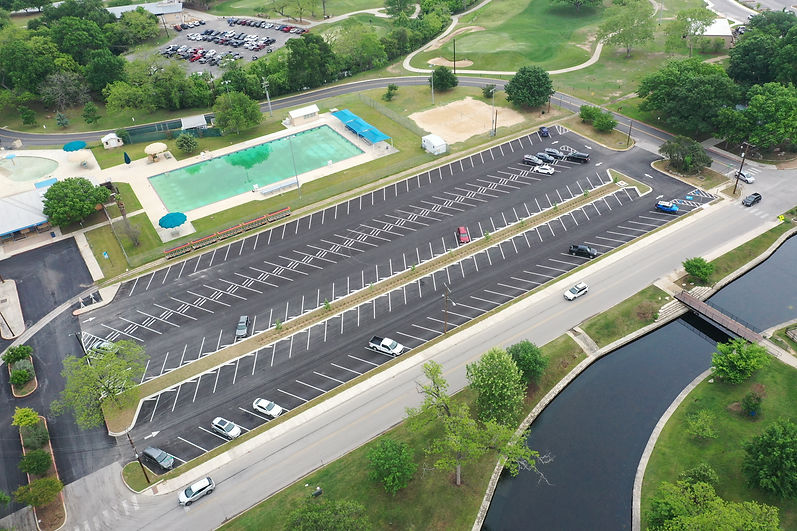
The two-acre Landa Park Aquatic Center Parking Lot and Bioretention System project elevated a typical parking lot repaving project into a water quality protection effort with economic, environmental, and quality of life benefits.

Project Description
The two-acre Landa Park Aquatic Center Parking Lot and Bioretention System project installed elevated a typical parking lot repaving project into a water quality protection effort with economic, environmental, and quality of life benefits. With funding from the Edwards Aquifer Habitat Conservation Plan, the Aquatic Center Parking Lot project models that a minimal extra investment can lead to major reduction in pollutants to the environment and benefits to the Comal River. Similar bioretention systems have been incorporated in several City capital improvement projects.
Vehicle wheel stops with a ribbon curb are designed so that parking lot runoff will sheetflow into the filtering basin and avoid concentrated discharge points and the potential for sediment accumulation that can impede water flow. The filter basin uses several layers of TCEQ-approved filtering media including sand, compost and other loamy soil types specifically designed not to compact as water carrying pollutants flows through. Similar to a French drain, the filter media trap pollutants while allowing the water to pass through to the series of drain pipes below. Strategically placed clean-outs allow the City to remove accumulated sediment from subsurface drain pipes. Existing trees were preserved and the bioretention outlet uses a 24” reinforced concrete pipe to connect to an existing storm water pipe that discharges filtered storm water to the Comal River.
One Water Shared Vision Elements

Plan for and manage water resources holistically and sustainably
The biofiltration system addresses water quality concerns by treating parking lot runoff before it enters endangered species habitat in Comal Springs.

Maximize environmental, social and economic benefits to New Braunfels
Environment: The system reduces non-point source pollution to benefit endangered species habitat and recreational activities.
Social: Additional signage explains the need and functionality of the system. The vegetative island improves the aesthetic qualities, provides shade, reduces heat island which enhances visitor experience and improves quality and function of park amenities.
Economic: The parking lot improvements are part of a larger Aquatic Center upgrade to attract and safely accommodate increased use. In the summer of 2025, there were almost 53,000 visits to the Landa Park Aquatic Center which generated nearly $345,000 in revenue for the City.

Ensure water remains a celebrated feature of our community
This project balances enhancing water quality for endangered species and recreation with water conservation benefits. The bioretention system uses a passive filtration system anchored by native and drought-tolerant vegetation that do not require supplemental irrigation.

Ensure healthy watersheds, waterways & groundwater resources
The advanced treatment and system design have been replicated in capital improvement projects where storm water quality improvements in the Comal River watershed.


Collaborating Partners
-
CoNB Parks and Recreation Board
-
CoNB Parks and Recreation Department
-
CoNB River and Watershed Division/Public Works
-
CoNB Transportation and Capital Improvements
-
Edwards Aquifer Authority
-
Edwards Aquifer Habitat Conservation Plan
-
Friends of Landa Park
One Water Components Incorporated
Demand Reduction
-
Water conservation measures: Established vegetation does not require supplemental irrigation.
-
Native and/or drought-tolerant plant selection: Lindheimer muhly and Texas sage are known for deep roots and low water demand.
-
Low-impact development techniques: Biofiltration is a common passive filtration approach with low maintenance requirements.
Water Quality Protection
-
Green storm water infrastructure: Vegetation slows the velocity of storm water and roots prevent erosion. The system uses layers of highly permeable, loamy soils to filter high volumes of runoff.
-
Low impact development: The system is designed to treat a 1.91 acre catchment area which includes 1.59 acres of impervious cover (83%) and is calculated to remove 1,427 lbs. of sediment per year.
Site Harvested Supply
-
Storm water capture: Water requirements of the vegetation are met through storm water runoff.
Integrated Management
-
Coordinated policies and programs: The system's water quality enhanced treatment are one of several collaborative conservation measures in the Edwards Aquifer Habitat Conservation Plan.
-
Community awareness, input and support: Increased signage raises awareness about the need and functionality of the system to protect sensitive habitat. This project involved input from several City departments and included thorough review by boards and stakeholders.


